
Cylinder Testing Services – Gas Bottle Testing NZ- Gas Bottle Test Date – LPG Gas Bottle Expiry Date
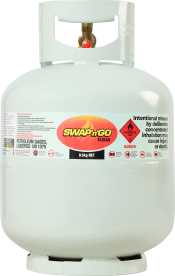 The LPG gas bottle expiry date and 9kg gas bottle testing are important for gas BBQ safety.
Required 9kg gas bottle testing in NZ is an integral part of BBQ gas bottle safety.
At ELGAS, all our gas bottles are subject to testing to meet the strict NZ standards for safety.
Our testing station technicians check gas bottle level of compliance, ensure testing and maintenance that meets the highest standards, so you can use your LPG in confidence for BBQs, home and commercial applications.
NZ Standards for Home and Commercial Gas Cylinders
There are no set NZ standards for gas bottle manufacturing and there are many manufacturers.
However, gas bottles need to be maintained in perfect working order according to NZ testing standards.
With the SWAP’n’GO® network of close to 6,000 dealers across NZ & Australia, including refilling operations, we take our gas cylinder testing services and safety seriously.
Gas bottles are marked with an LPG gas bottle expiry date stamp so you know when the next cylinder testing date is due.
If your gas bottle is undamaged it can be refilled any number of times prior to the LPG gas bottle expiry date.
Does LPG Gas Go Off – LPG Go Bad
No, LPG does not go off, however, LPG tanks do expire and require periodic reinspection.
LPG gas is chemically stable has a virtually infinite shelf life and will not go bad or lose potency over time in a properly sealed tank.
However, LPG tanks must be periodically safety checked for structural integrity.
The steel can rust or become damaged causing it to fail inspection.
The gas bottles are typically reinspected every 10 years through visual inspection or a hydrostatic pressure test.
Gas Bottle Testing NZ – Gas Bottle Test Date – LPG Gas Bottle Expiry Date
Gas bottle testing in NZ is necessary because it is dangerous and also illegal to fill past the LPG gas bottle expiry date or to fill damaged cylinders without new testing.
The gas bottles require testing and re-stamping by approved gas cylinder testing services.
If installing LPG at your home or business, the installation must be performed by a qualified gas fitter.
You will also need to store the gas bottles in a safe location.
Complete periodic testing of an LPG cylinder every 10 or 15 years should include:
- LPG gas bottle expiry date confirmation
- degassing prior to testing
- internal inspection to check gas bottle level of corrosion
- external inspection to check gas bottle level of corrosion
- valve inspection or replacement
- new LPG gas bottle expiry date stamp after successful testing
Where is the Expiry Date on a Gas Bottle
 The LPG gas bottle expiry date is stamped into the metal on the gas bottle neck. See image.
In NZ, a BBQ size gas bottle is good for ten years after the testing date.
External Gas Bottle Inspection – Check Gas Bottle Level of Defects
 The external surface of the gas bottle is inspected for defects, as defined by the applicable testing Standard.
Failure in any one category of the gas bottle inspection is cause for condemning the gas bottle.
Testing Preparation by De-gassing
 At the start of the testing process, the gas bottle is totally emptied of any remnant gas.
The old gas valve is then removed to facilitate the internal inspection.
Internal Inspection & Check Gas Bottle Level of Corrosion
 Testing includes an internal inspection to check gas bottle level of corrosion.
Any gas bottle that fails to meet the gas bottle inspection Standard is condemned.
Cylinder Neck
The neck of the gas bottle is a critical area of testing as it is the point of attachment for the valve.
Once again, failure in any area of testing is cause for condemnation.
New 9kg Gas Bottle Expiry Date
 A 9kg gas bottle that pass all of the testing is stamped with a new 9kg gas bottle expiry date, showing the month and last two digits of the year.
Valve Installation After Successful Testing Procedure
 After successful testing, the next step is the installation of a new valve, as shown in the picture.
The old valves are discarded and recycled.
LPG Gas Tank Testing for Vehicles
 LPG gas tank testing (LPG tank testing) in vehicles must also be inspected every ten years.
The Autogas LPG gas tank testing includes structural integrity, internal and external inspections to check gas bottle level of corrosion, and pressure relief valve functionality.
The LPG gas tank testing expiry date is the same story as for other gas bottle expiry date, and checks are mandatory.
As with other gas cylinders, it is illegal to refill an out-of-date gas expiry.
Gas Bottle Disposal of Expired and Damaged Gas Cylinders
Even the toughest steel has its days, and SWAP’n’GO bottles and other large cylinders that fail testing are condemned.
 Expired and faulty gas bottles are safely retired by punching a large hole in the side so metal recycling workers know the cylinder has been safely decommissioned.
In addition to recycling the steel from the gas bottles, the brass from the valves is also recycled.
Everything is taken care of by ELGAS experts who are experienced in retesting out-of-date cylinders, detecting gas leaks and other testing services.
Your old gas bottle can be exchanged for one in as-new condition for no extra charge at ELGAS and SWAP’n’GO®.
How to Check Gas Bottle Level
There are some gas bottle testing procedures you can perform yourself, including how to check gas bottle level.
The easy steps to follow to check gas bottle level are:
- Pour warm water (not boiling water) down the side of the bottle.
- Wait a minute.
- Run your hand down the side of the bottle.
- It will feel cool to the touch at the level of LPG and you may notice a condensation line.
- You’ve just done a check gas bottle level so now know how much gas is left in your bottle.
- Does your bottle need a refill? Contact ELGAS or visit your nearest SWAP’n’GO retailer
Please see: How to Check Gas Bottle Level – Check Level of Gas Bottle
Gas Bottle Testing and Refilling Your LPG Gas Cylinder
LPG is used for numerous applications that include cooking, heating, and hot water, so it is an important safety consideration to ensure your gas cylinder is in top working order.
In general, your gas cylinders can be automatically replaced with in-date ones.
That’s the beauty of being an ELGAS customer or a SWAP’n’GO customer.
Make sure to check your gas bottle expiry date stamp periodically to ensure it hasn’t expired.
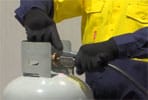 Refilling – While not part of the formal gas bottle testing (LPG tank testing) process, the new valve installation should always be leak tested when refilled.
In fact, this is the standard procedure for all subsequent refilling, as well.
Refurbishment – In addition to the normal gas bottle test procedures, over half of the bottles tested by SWAP’n’GO are also cleaned and repainted.
The end result is a refurbished gas bottle in as new condition with a new 9kg gas bottle expiry date stamp that’s valid for ten years.
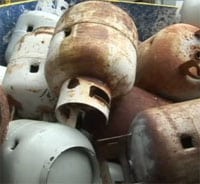 Recycling – SWAP’n’GO bottles that are condemned are safely decommissioned.
In addition to recycling the steel from the gas bottles, the brass from the valves is also recycled.
Gas Bottle Testing with Licensed Gas Cylinder Testing Services
All testing must be performed by a registered test station.
LPG is a volatile gas with power when under pressure, so it makes sense to trust the experts at ELGAS.
After the gas bottle expiry date, LPG cylinder testing (LPG tank testing) must be performed.
The ELGAS gas bottle testing (LPG cylinder testing) services technician will stamp a new gas bottle expiry date into the neck ring if the LPG gas cylinder is in top working order.
Here is a summary of the previously discussed LPG gas bottle testing procedures involved:
- A determination that the gas bottle expiry date has been reached.
- External gas bottle testing is performed.
- The LPG cylinder is degassed to allow for internal gas bottle testing and to check gas bottle level of corrosion.
- The old valve is removed and an internal gas bottle testing inspection is done to check gas bottle level of contamination.
- The cylinder neck and valve threads are inspected for any damage.
- A new gas bottle expiry date is stamped into the cylinder neck ring.
- A new valve is installed after the successful completion of LPG gas bottle testing.
- Any required refurbishment, including painting, is performed.
- The gas cylinder is ready for refilling and return to use.
- Any gas cylinders that fail the gas bottle testing, at any point are condemned and recycled.

Eric has served on multiple committees for the World LPG Association (WLPGA), contributing to important discussions and advancements within the global LPG sector. He has presented at WLPGA Annual Conferences, sharing his expertise as a speaker, panellist, and panel chair.
- Can Gas Tanks Explode? Gas Bottle – Gas Cylinder Explosion - August 5, 2026
- What Size Hot Water Cylinder Do I Need – NZ - August 5, 2026
- Can You Leave a Gas Bottle in the Sun - July 29, 2026